
The Best Signal-Based B2B Software in the Netherlands and Europe

Sjors Teeuwen
GTM Strategy Lead

Key Takeaways
- •Signal-based B2B software turns website, LinkedIn, email and company-level events into a picture of buying momentum, not just activity
- •The market splits along two axes: account-level vs person-level intelligence, and intent detection vs activation
- •6sense and Demandbase lead on enterprise account-based intent, UserGems and Common Room lead on person-level signals, Clay leads on GTM engineering flexibility
- •Stairoids combines company and person-level signals with scoring and orchestration into a single GTM Intelligence layer
- •The next evolution is GTM Inreach: recognizing who is already moving toward you, before they convert into a lead
- •More signals isn't the answer - the winning teams build the intelligence layer that turns signals into prioritized action
B2B sales and marketing have spent years getting better at answering one question: who could we sell to?
We built ICPs. Bought databases. Implemented CRMs. Added enrichment. Automated outbound. Created ABM programs.
But that still leaves a much more valuable question unanswered: who should we focus on right now?
That is where signal-based B2B software comes in. Signal-based GTM platforms use behavioral, company and person-level signals to help revenue teams understand where actual commercial momentum is developing.
A company visits your website. A decision-maker interacts with your LinkedIn content. Someone from the buying group returns several times. Another stakeholder engages with an email. The company starts hiring. Multiple people from the same account suddenly become active. Individually, these are signals. Combined, they can become buying momentum.
In this guide, we look at some of the most relevant signal-based B2B platforms for companies in the Netherlands and Europe, including Stairoids, 6sense, Demandbase, UserGems, Common Room, Clay, Unify, Factors.ai, Warmly, Salesmotion, Apollo and Dealfront. Importantly, this is not a ranking - these platforms solve different parts of the signal-based GTM problem.
What is signal-based B2B software?
Signal-based B2B software detects events and behavioral patterns that can indicate commercial relevance. Those signals can include website visits, content engagement, LinkedIn activity, email engagement, job changes, company growth, funding events, hiring, advertising engagement, CRM activity and third-party intent.
But collecting signals is only the beginning. A good signal-based GTM strategy should ultimately help answer:
- • Does this company fit our ICP?
- • Which people are involved, and are they relevant buyer personas?
- • Is activity increasing?
- • Is a buying group or DMU becoming visible?
- • How strong is the buying momentum?
- • Should marketing or sales act, and what should happen next?
That is the difference between signal detection and signal intelligence.
The Signal-Based GTM Tools Matrix
One of the easiest ways to understand the current market is to stop putting every signal platform into the same category. They aren't.
A useful framework is to look at two dimensions:
Axis 1
Account-level intelligence → Person-level intelligence
Axis 2
Intent detection → Activation and orchestration
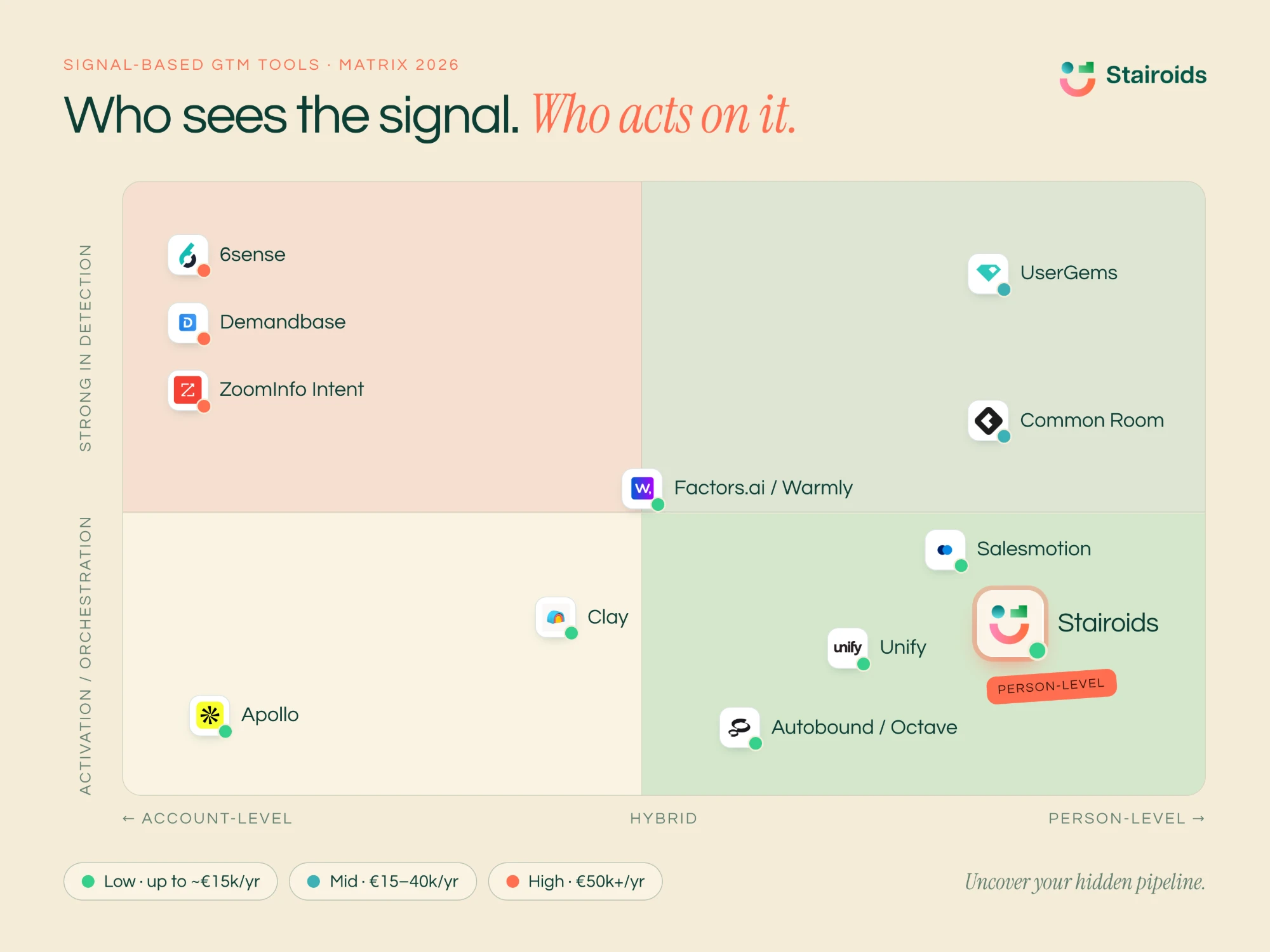
Platforms such as 6sense and Demandbase have historically approached intent and GTM heavily from an account perspective. Platforms such as UserGems and Common Room bring individual people and their activity much more prominently into the equation. Tools such as Clay give GTM teams enormous flexibility to build their own data, enrichment and activation workflows. And platforms such as Stairoids combine company and person-level signals with scoring, buying-group intelligence, prioritization and activation.
The point of the matrix is not to declare one universal winner. It shows that "signal-based software" now describes several fundamentally different approaches. Let's look at them.
Platform-by-platform: Stairoids, 6sense, Demandbase & more
Stairoids: Signal-Based GTM Intelligence and Inreach
Stairoids is a Dutch Signal-Based GTM Intelligence platform built around a simple idea: don't just collect signals, understand who is moving and act on that momentum.
Stairoids continuously brings together signals around companies and people. These can include website activity, LinkedIn activity, engagement with people inside your organization, email and newsletter engagement, advertising activity, company events and other relevant GTM signals. Those signals are then interpreted within the context of your ICPs, buyer personas and decision-making units.
This is important because a signal without context can easily become noise. A random website visit from an irrelevant company shouldn't have the same value as repeated activity from a target account where several relevant buyer personas are becoming active.
From individual signals to buying momentum
Stairoids uses its Intentional Wire Score (IWS) to dynamically score companies and people based on their signals, fit, relevance, timing and recency. Signals can lose relevance over time, new signals can increase momentum, and multiple relevant people becoming active can change the picture entirely.
The result is not simply another feed filled with activities. It is a continuously changing view of who deserves attention right now. The Rush Funnel then helps visualize organizations moving from Cold Start toward stronger states of buying momentum, while Sales Outreach helps teams see which people inside those organizations are relevant and why.
From intelligence to activation
This is where Stairoids moves beyond signal detection. The intelligence can be used to trigger actions across the GTM stack. A relevant signal, score, funnel stage or custom combination of filters can trigger actions through integrations, APIs, Zapier, MCP and automation platforms - adding someone to an outreach sequence, changing an advertising audience, updating the CRM, notifying sales or triggering another GTM workflow.
The idea is that Stairoids becomes an intelligence and orchestration layer between your data and your execution platforms.
Best suited for: European B2B companies and agencies that want to combine company and person-level signals, identify buying momentum and activate marketing and sales from one GTM intelligence layer.
6sense: Enterprise Account-Based Revenue Intelligence
6sense is one of the established names in B2B intent and account-based marketing. The platform combines first-party and third-party intent, CRM and marketing automation data with predictive modeling, which is used to determine account buying stages and help revenue teams prioritize accounts. 6sense's intent score is updated daily and is designed to estimate the likelihood of an account opening an opportunity within the following 90 days.
6sense has also expanded well beyond simple intent detection, with account and contact fit models, persona intelligence, and advertising and activation capabilities - making it particularly relevant for larger organizations running sophisticated ABM and revenue marketing programs. The conceptual starting point, however, remains strongly connected to accounts, buying stages and account-based GTM.
Best suited for: larger B2B organizations running mature ABM programs that need predictive account intelligence, intent data and enterprise-scale activation.
Demandbase: Account-Based GTM and Intent Intelligence
Demandbase is another established platform in the account-based GTM category. Its approach combines account intelligence, intent and activation to help sales and marketing coordinate around target accounts.
Demandbase makes an important point about modern intent data: intent is a signal, not proof that somebody is ready to buy. It recommends combining intent with account fit, first-party engagement, CRM data and buying-group information before deciding how to act.
That is an important evolution. Traditional ABM was largely about identifying and targeting the right accounts. Modern signal-based GTM increasingly asks what is actually happening inside those accounts. Demandbase describes its Account-Based Experience approach as using data and insights to orchestrate relevant marketing and sales actions throughout the B2B customer journey.
Best suited for: enterprise B2B organizations looking for an extensive account-based GTM, intent and activation platform.
UserGems: Person and Company Signals for Sales
UserGems is particularly interesting because it puts people much more prominently into signal-based selling. The platform distinguishes between people signals, such as past champions moving to another company, new hires, promotions and role changes, and company signals, such as funding, acquisitions, hiring momentum and other account-level changes.
UserGems has expanded this model further with signals around website visitors, ad engagement, email engagement, account intent and other first-party activities - making it an interesting example of the market moving away from purely account-level intent toward person + account intelligence.
Best suited for: sales organizations that want person-level events and account signals to determine who sales should engage and why.
Common Room: Person-Level GTM Intelligence
Common Room approaches the problem from another angle. It has become known for bringing together digital interactions and identifying the people and organizations behind them. For teams with buyers interacting across communities, social platforms, product environments and other digital channels, this can provide a much richer picture than CRM data alone.
Your buyers are leaving traces in many different places. The challenge is connecting those traces to actual people and accounts.
This places Common Room relatively far toward the person-level intelligence side of the signal-based GTM landscape.
Best suited for: modern GTM teams that want to identify and understand people engaging across multiple digital channels.
Clay: Build Your Own Signal-Based GTM Engine
It is almost impossible to discuss modern GTM engineering without discussing Clay. Rather than primarily providing a predefined interpretation of buying momentum, Clay gives GTM teams the building blocks to construct sophisticated data and enrichment workflows themselves - combining data providers, enriching organizations and contacts, running AI research, creating scoring logic and triggering downstream workflows.
That flexibility has made it extremely popular among GTM engineers, RevOps professionals and advanced outbound teams. The key question Clay helps answer is often: how do we build the data and workflow required for this GTM motion? A signal intelligence platform approaches the problem somewhat differently: what is happening right now, what does it mean, and who should act?
That means the technologies can also complement each other: Clay as an enrichment and GTM engineering layer, while another platform continuously interprets the buying momentum occurring across the market.
Best suited for: GTM engineers and RevOps teams that want maximum flexibility in enrichment, research and workflow design.
Unify: Signals Meet Outbound Execution
Unify sits closer to the activation side of the landscape. Its approach connects signals with automated outbound workflows, helping teams turn events and intent into sales plays.
That addresses one of the biggest problems with intent data: a signal sitting inside a dashboard doesn't generate pipeline. Someone, or something, has to act on it. Platforms such as Unify therefore represent the convergence between signal detection and outbound execution.
Best suited for: outbound-focused revenue teams that want signals to automatically feed prospecting and sales workflows.
Factors.ai and Warmly: Website Intent Meets GTM Activation
Factors.ai and Warmly operate around an interesting part of the landscape where website activity, account identification, intent and activation increasingly overlap. Historically, website visitor identification answered a relatively simple question: which company visited our website? The newer generation of platforms attempts to make that information more actionable by combining it with account context, scoring, routing and sales workflows.
That makes this category particularly interesting for organizations with significant B2B website traffic. The important distinction remains whether the platform primarily identifies account activity or can connect that activity with the actual people and buying group behind it.
Best suited for: B2B teams that want to turn website activity and account intent into faster sales action.
Salesmotion: Trigger-Based Sales Intelligence
Salesmotion focuses on helping sales teams understand changes happening inside their target accounts. Company events and commercial triggers can provide sellers with context for why an account may suddenly become more relevant, which is particularly valuable in outbound motions where timing matters.
Instead of contacting an account simply because it matches a static list, a trigger gives sales a reason for why now might be more relevant than three months ago.
Best suited for: sales teams looking to prioritize accounts using company events and trigger-based intelligence.
Apollo: Prospecting Data with Signals
Apollo sits closer to the traditional prospecting and sales intelligence side of the market. Its core value is access to B2B company and contact data combined with prospecting and sales engagement capabilities, making it useful when the primary challenge is: who can we contact and how can we reach them?
Signal-based GTM adds another layer: which of those people should we contact right now? Having 100,000 prospects in a database does not mean that 100,000 prospects deserve attention today.
Best suited for: sales teams that need a large prospecting database combined with sales engagement capabilities.
Dealfront: European Company and Website Intelligence
For European B2B companies, Dealfront deserves particular attention because of its European focus. Dealfront combines company intelligence with website visitor identification and sales intelligence, making it useful for organizations wanting to understand which companies fit their target market and which organizations are interacting with their website.
Website identification remains one of the most tangible forms of first-party intent, but it is also only one part of the buyer journey. The next step is understanding what else is happening around that organization and which actual people may be involved.
Best suited for: European sales teams looking for company intelligence and website-based intent.

What about Trigify?
Trigify would have belonged in this comparison until very recently. That changed in September 2026.
On September 23, 2026, Trigify announced that its team was joining HubSpot. As part of that transition, the standalone Trigify platform is being retired. For customers on its standard notice period, access ends on October 22, 2026 at 11:59 PM BST.
That is why we have not included Trigify as a standalone option in this comparison. The development is nevertheless noteworthy: Trigify says its team will bring its expertise in signals, data and context into HubSpot. It is another interesting sign of how strategically relevant signal intelligence is becoming within the broader GTM technology market.
Account-Level Intent vs. Person-Level Buying Signals
This may be the most important distinction when comparing these platforms.
Imagine Stairoids detects that Company X has visited your website several times. Useful. Now imagine you can also see that the company's Head of Sales interacted with your LinkedIn content, a second decision-maker viewed the LinkedIn profile of someone on your team, another relevant person engaged with your newsletter, the company fits your ICP, and several members of the expected DMU are simultaneously becoming active.
You no longer have a website signal. You have a pattern. And that pattern is much closer to actual buying momentum.
This is why the signal-based GTM market is increasingly moving from Account → Activity toward Account → People → Buying Group → Momentum → Action.
Signals Are Not the Same as Intent
This distinction is equally important. One pageview does not mean someone wants to buy. One LinkedIn like does not mean someone wants a demo. One email click doesn't mean there is a project. And one third-party intent signal doesn't automatically mean an account is in-market.
The value comes from context and combination:
- • Which signal happened, and who generated it?
- • Does that person match a relevant buyer persona?
- • Does the organization match your ICP?
- • What happened before, and are other people from the same organization active?
- • How recent are those signals, and is activity accelerating?
That is why the future of signal-based GTM isn't simply about collecting more signals. It is about making signals meaningful.
From Signal-Based GTM to GTM Inreach
This brings us to what we believe is the next evolution of the category: GTM Inreach.
Almost every B2B organization has an Outreach motion. Teams build lists, enrich contacts, launch sequences, run LinkedIn campaigns, deploy AI SDRs, call prospects, send emails. The underlying question is: who should we reach out to?
Inreach reverses the starting point. It asks: who is already moving toward us? Inreach is the process of recognizing companies and people that are already showing buying momentum toward your organization before they formally convert into a lead.
Your website is part of Inreach. Your LinkedIn ecosystem is part of Inreach. Email engagement can be part of Inreach. Advertising engagement can be part of Inreach. Your colleagues' networks can generate signals. Company events can provide context. And multiple people becoming active inside the same account can reveal an emerging buying group.
The best Outreach therefore doesn't necessarily start with another prospecting database. The best Outreach starts by recognizing Inreach.

Why Your CRM Alone Isn't Enough
CRM remains essential. HubSpot, Salesforce, Pipedrive and other CRM platforms are where companies manage relationships, contacts, opportunities and commercial processes.
But CRM fundamentally works best when something is already known: a contact exists, a lead converted, a salesperson created an opportunity, an activity was logged.
Signal-based GTM moves further upstream. It tries to understand what is happening before the traditional sales process becomes visible. That means the future GTM architecture increasingly looks something like:
Signals → Intelligence → Prioritization → Activation → CRM → Revenue
Rather than replacing CRM, signal intelligence makes the rest of the stack smarter.
The Rise of the GTM Intelligence Layer
Most B2B organizations already have plenty of technology: CRM, marketing automation, LinkedIn Ads, sales engagement, email marketing, enrichment, data providers, AI tools, automation.
The problem isn't necessarily that another tool is missing. What's missing is often the intelligence connecting those tools. Something needs to decide:
- • Who matters, and why now?
- • What changed?
- • Who inside the organization matters?
- • What should happen next?
That is the role of the emerging GTM intelligence layer. Instead of every tool operating independently, the intelligence layer becomes the central brain or cockpit of the GTM stack.
Signal-Based B2B Software Comparison
Here is a simpler way to think about the different platforms covered in this article:
| Platform | Primary Focus | Typical Starting Point |
|---|---|---|
| Stairoids | Signal-Based GTM Intelligence & Inreach | Which companies and people are building momentum, and what should happen next? |
| 6sense | Predictive ABM & Revenue Intelligence | Which accounts are showing intent and progressing through buying stages? |
| Demandbase | Account-Based GTM & ABX | Which target accounts should marketing and sales engage? |
| UserGems | Person & Company Signals | Which people or accounts have experienced a relevant change? |
| Common Room | Person-Level GTM Intelligence | Who is interacting with us across digital channels? |
| Clay | GTM Engineering & Enrichment | How can we build and enrich the GTM workflow we need? |
| Unify | Signal-Based Outbound | Which signals should trigger outbound actions? |
| Factors.ai / Warmly | Website Intent & Activation | Which organizations are showing website intent? |
| Salesmotion | Company Triggers | What changed at our target accounts? |
| Apollo | Prospecting & Sales Intelligence | Who can we contact? |
| Dealfront | European Company & Website Intelligence | Which companies fit and which are visiting our website? |
The right choice therefore depends on the problem you are trying to solve.
What Should European B2B Companies Look For?
For companies in the Netherlands and Europe, there are several additional considerations. GDPR and data retention matter. European company coverage matters. Integrations with the rest of your GTM stack matter.
But beyond those basics, we believe organizations should ask a more fundamental question:
Are we buying another source of data, or are we buying intelligence?
- • If you don't know which companies visit your website, website identification can solve a very specific problem
- • If you need more contacts, a prospecting database can solve that problem
- • If you need sophisticated enrichment, a GTM engineering platform can solve that problem
- • If you run enterprise ABM, predictive account intent can solve another set of problems
But if you already have plenty of data and tools and still struggle to determine where marketing and sales should focus today, adding another dataset may not solve the problem. You may need an intelligence layer.
So, What Is the Best Signal-Based B2B Software in Europe?
There isn't one platform that is the right choice for every use case. The market is too diverse for that.
- • 6sense and Demandbase provide extensive capabilities around enterprise account-based GTM and intent intelligence
- • UserGems brings people signals and company signals together for trigger-based selling
- • Common Room focuses heavily on understanding the people and organizations interacting across digital channels
- • Clay gives GTM engineers enormous freedom to construct custom data and enrichment workflows
- • Unify connects signals closely to outbound execution
- • Dealfront offers a particularly relevant proposition for European company and website intelligence
And Stairoids is built around bringing multiple signal types together at company and person level, interpreting their combined buying momentum and turning that intelligence into marketing and sales action.
The choice depends on which layer of the problem you actually need to solve.
Frequently Asked Questions
What is signal-based B2B software?
Software that detects behavioral and company-level events, such as website visits, LinkedIn activity, email engagement, hiring and funding, and interprets them in the context of your ICP and buyer personas to reveal buying momentum.
What is the difference between account-level intent and person-level buying signals?
Account-level intent tells you a company may be in market. Person-level buying signals go further, showing which named individuals inside that company are actually engaging, which matters because deals are won by people, not by anonymous accounts.
What is GTM Inreach?
GTM Inreach is the process of recognizing companies and people that are already showing buying momentum toward your organization, across your website, LinkedIn, email and network, before they formally convert into a lead.
Is there one best signal-based B2B software platform?
No. The market is too diverse for a single winner. 6sense and Demandbase lead on enterprise account-based intent, UserGems and Common Room lead on person-level signals, Clay leads on GTM engineering flexibility, and Stairoids combines company and person-level signals with scoring and activation into one GTM Intelligence layer.
The Future of B2B GTM Is Not More Data
For years, B2B technology has helped us collect more: more accounts, more contacts, more enrichment, more website data, more intent data, more activities, more dashboards, and now more AI.
But GTM teams don't necessarily need another million data points. They need to know which ten accounts matter today, which people inside those accounts matter, why something is happening now, and they need their GTM stack to respond.
That is why the next phase of B2B GTM will not simply be about signals. It will be about the intelligence connecting those signals.
Signal → Context → Momentum → Prioritization → Activation. Or, even simpler: who matters, why now, and what should happen next?
That's Signal-Based GTM Intelligence. That's Inreach. And that's exactly the layer we're building with Stairoids.